Apify Store: where publishing ends and monetization begins (and the 14-day rule in between)
Apify Store: where publishing ends and monetization begins (and the 14-day rule in between)
Not legal, tax, or investment advice. Mechanics below come from docs.apify.com (Publish, Set up monetization, Monetize, Pay per event, Actors in Store) and the Store Publishing Terms, archived 2026-10-15 (Asia/Shanghai). Console behaviour changes, so re-open the pages before you change price. This article links none of our products or Actors.
This article is not a Store publishing checklist. Related reading on pricing claims: this guide. Here the only job is: the seam between publishing and monetization — the timing rules that decide when a price takes effect, and how they change how you should launch.
1) Lead answer
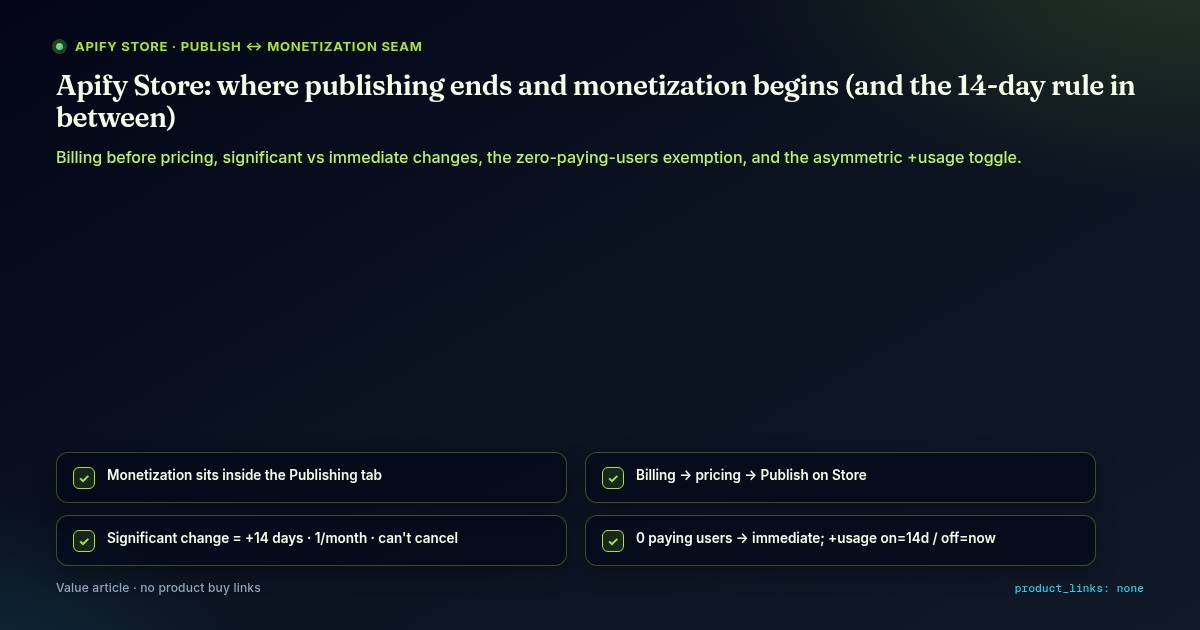
- Monetization sits inside the Publishing tab. You complete Display information, Monetization, Sample output, Output schema, and Actor permissions, then press Publish on Store (Publish).
- Billing and payment details come first. Set up monetization: “first complete your billing and payment details. Then, you can define the pricing” (Set up monetization). KYC is what payouts need; it is not a step for publishing (Terms §10.1.2–10.1.3).
- Significant changes (pricing-model change, price increase, new paid event) notify users and take effect after 14 days. During that window the old pricing applies. You can’t cancel or modify a submitted change (support only), you get one per month per Actor, and a pending change blocks new ones (Set up monetization; Terms §9.4).
- Exemption: “if your Actor has no paying users, the waiting period doesn’t apply and the change takes effect immediately.”
- Non-significant changes are immediate: price decreases, removing events, description edits, non-pricing settings.
- The “Pay per event + usage” toggle is asymmetric: turning it on takes 14 days; turning it off is immediate because it is “a positive change for users” (PPE).
2) Order of operations at the seam
| Step | Where | Why it matters at the boundary |
|---|---|---|
| Billing + payment details | Account | Required before defining pricing (set-up-monetization) |
Actor pricing: synthetic apify-actor-start / apify-default-dataset-item, custom events, +usage, min max-cost-per-run |
Publishing → Monetization | Defines what a user pays on the first run |
| Primary event | same | Defaults to dataset event / only event |
| Review → confirm | same | Pricing locked in as current pricing |
| Other Publishing sections → Publish on Store | Publishing | Actor becomes a public Store product (Publish) |
| KYC / Verified Creator | Account | Needed for payouts (§10.1.2); unpaid accruals withheld 12 months are forfeited (§10.1.6) |
| Agentic-payment eligibility | automatic | PPE only, no +usage, limited permissions, no Standby, and KYC (Monetize) |
Whether Console lets you publish with no monetization section completed (as opposed to choosing pay-per-usage) is Not verified.
3) Significant vs non-significant: the timing table
| Change | Class | When it applies |
|---|---|---|
| Pricing model switch (e.g. pay-per-usage → PPE) | Significant | +14 days, users notified |
| Raise an event price | Significant | +14 days |
| Add a new paid event | Significant | +14 days |
| Turn on PPE + usage | (PPE page) | +14 days |
| Any of the above with zero paying users | Exempt | Immediate |
| Lower a price | Non-significant | Immediate |
| Remove an event | Non-significant | Immediate |
| Turn off PPE + usage | Positive | Immediate |
| Edit event descriptions / non-pricing settings | Non-significant | Immediate |
Worked calendar (hypothetical): submit a price increase on 2026-10-15, and it takes effect 2026-10-29. You can’t submit another significant change while that one is pending. With “once per month per Actor,” plan the next one around mid-November. Whether “month” means a calendar month or a rolling 30 days is Not verified.
Worked profit (hypothetical PPE, 1,000 results, $0.50 platform cost; 80% − costs per Terms §10.2.1): $2/1k gives $1.10 profit and $3/1k gives $1.90. Until day 14 you earn at the old rate, so don’t book the higher number early.
4) Free → paid on an already-published Actor
The docs don’t say “free → paid” in those words. They do define it through the rules above:
- Moving from pay-per-usage (users pay only platform usage) to PPE is a pricing-model change, which makes it significant: users are notified and it takes effect after 14 days.
- Adding a paid event on top of existing PPE is also significant.
- If nobody pays yet, the change is immediate, so the cheapest moment to settle pricing is before paying users show up.
- Free-plan users: if you limit them, say so up front in the README and input schema, exit gracefully with a clear message, and never dress a policy limit up as a bug (Monetize).
- Set-up-monetization warns against “high prices exclusively for users on a free plan.”
- Announcement duty: Apify notifies users of significant changes. The docs don’t say whether creators must post their own notice. Updating the README to match the current price (not the pending one) is the honest default. The exact notification channel is Not verified.
- Rental: since 2026-04-01 you can’t publish new rental Actors or change rental pricing; since 2026-10-01 rental is retired and remaining Actors moved to pay-per-usage (Actors in Store). Don’t plan a “rental → paid” path now.
5) Publish-side rules that bite monetized Actors
From the Store Publishing Terms:
- §2.2.4.2: no promoting off-platform products in the README or description, and no review incentives or self-reviews. You can’t route paid users to an external checkout from the Store page.
- §3.2: Apify may run promotional pricing, coupons, and discounts on your Actor. Don’t promise “price never changes.”
- §7.1 / §10.2.2: a Faulty Actor can be marked under maintenance and deprecated after 30 days. No payout accrues while it is Faulty.
- §8.1: user Issues must be addressed within 14 days, or the Actor can be declared Faulty.
- §9.2: profit and payout figures in the UI are estimates.
6) Seam self-check
- Billing details done before opening Monetization?
- Is the first public price the one you can live with? (Before paying users, changes are immediate; after, it’s 14 days and once a month.)
- No pending significant change you might want to undo? (It can’t be cancelled.)
- README/input schema state free-plan limits and the current price?
- Not counting on PPE + usage as a temporary bump? (On takes 14 days, off is instant.)
- KYC planned so earnings aren’t stuck (12-month forfeit)?
- No off-platform checkout links on the Store page?
7) Not verified
- Calendar month vs rolling 30 days for “once per month.”
- The channel and wording of Apify’s user notification for significant changes.
- Publishing with no monetization section completed.
- Whether unpublish → republish resets the timing rules.
- Whether a price change made during an Apify-run promotion (§3.2) counts as significant.